The infrastructure behind AI agents is evolving faster than the infrastructure that powered RPA.
Your UiPath bots broke four times last quarter. Every time a vendor updated their portal, your team spent two days patching selectors. Meanwhile, your competitor automated the same workflows in a weekend using AI agents that just figured it out. For definitions of key terms, see our AI Glossary.
This is not a hypothetical. It is the operational reality for thousands of enterprise teams in 2026. Gartner projects 40% of enterprise applications will embed AI agents by end of 2026, up from fewer than 5% in 2025. The question is not whether the shift is happening. It is whether your business process automation strategy keeps up.
This guide compares RPA and AI agents on the dimensions that matter most to buyers evaluating an RPA alternative: what each technology actually does, where each wins, how they differ in maintenance and cost, and how to migrate without disrupting production workflows. For a deeper look at intelligent automation fundamentals, see our guide on agentic automation.
Key Takeaways
- RPA follows deterministic scripts; AI agents reason through tasks using large language models. The difference matters most for exception handling and unstructured data.
- 30 to 40% of enterprise RPA maintenance hours go to repairing breakage (Gartner, 2025). AI agents reduce that to under 10%.
- RPA wins for stable, structured, high-volume processes with fixed inputs. AI agents win where inputs vary or require judgment.
- 57% of companies already have AI agents in production (G2 Enterprise AI Agents Report, 2025).
- You do not need to rip and replace. The recommended RPA migration path is augment-then-replace over 12 to 24 months.
- The RPA alternative that matters most is not a different RPA tool. It is agentic process automation powered by AI.
What Is RPA and Why Did It Dominate the 2010s?
Robotic Process Automation mimics human actions through predefined scripts. A bot navigates to a screen, reads a field, writes a value, and repeats. For a decade, this was the state of the art in workflow automation.
RPA solved a real problem: legacy enterprise systems often lacked APIs, making programmatic integration impossible. Bots automated at the presentation layer, navigating screens exactly as a human would. UiPath, Automation Anywhere, and SS&C Blue Prism became household names in enterprise IT.
The results were tangible. Early adopters commonly reported cost reductions in the 25 to 50% range on targeted business process automation projects. Error rates dropped. Throughput increased. RPA grew into a multi-billion-dollar software category.
What RPA Does Well
RPA excels at three things:
- Structured, high-volume data movement. Moving records between systems, batch processing, scheduled report generation.
- Deterministic workflows. Every step is known in advance. No judgment required. No ambiguity in inputs.
- Legacy system integration. When there is no API, screen scraping works. RPA bots interact with the UI layer, bypassing the need for backend connectivity.
“RPA harvested the structured-data, high-volume use cases. The remaining 80% of work is unstructured, judgment-heavy, and exception-driven.” (Kognitos, 2026)
Where RPA Starts Breaking Down
The limitations emerge as bot estates grow:
- Brittle selectors. RPA interacts with the code underlying an application using HTML IDs or XPaths. When a vendor updates a screen, the bot breaks. Industry estimates widely cited across automation research put 30 to 40% of RPA maintenance hours toward repairing this kind of breakage.
- No unstructured data handling. 80% of enterprise data is unstructured: emails, PDFs, contracts, chat logs. RPA cannot process any of it without rigid templates.
- Escalating maintenance costs. A bot that handles 10,000 transactions per month needs constant monitoring. As the estate grows, so does the team needed to babysit it.
- Zero adaptability. Every new edge case requires a developer to write a new conditional path. The automation strategy that worked for 50 bots collapses at 500.
What Are AI Agents and Why Are They Different?
RPA maintenance hours, exception rates, and scaling costs all run 3 to 5x higher than AI agents.
AI agents are autonomous software systems that use large language models (LLMs) to perceive their environment, reason about a task, plan a sequence of actions, and adapt based on intermediate results. This is the core of agentic AI applied to enterprise automation.
The shift is from instructions to goals. You do not tell an AI agent where to click. You tell it what to achieve: “Process this invoice and create a record in the ERP.” The agent determines the steps itself. This is what makes agentic process automation fundamentally different from traditional workflow automation.
The Three Capabilities That Separate AI Agents from RPA Bots
1. Natural language understanding AI agents parse unstructured text, emails, PDFs, and voice transcripts without predefined field mappings. An RPA bot can move a file from an email to a folder. An AI agent reads the email, understands the customer intent, extracts the relevant order number, and drafts a response. This is AI-powered automation that handles the 80% of enterprise data that RPA ignores.
2. Tool use at runtime Agents call APIs, query databases, and trigger downstream actions as part of reasoning, not as pre-scripted steps. If the first approach fails, the agent tries another path. No developer intervention required.
3. Exception handling through reasoning When an unexpected input arrives, the agent reasons about how to proceed rather than halting and throwing an exception to a human queue. Among teams that replaced high-exception RPA bots with AI agents, median exception rates dropped from above 15% to under 3% within 30 days (G2, 2025). This is the single biggest operational difference when evaluating any RPA alternative.
RPA vs AI Agents: The Comparison That Matters
Here is the side-by-side on the six dimensions enterprise buyers actually evaluate when comparing RPA vs AI agents.
Autonomy and Decision-Making
RPA executes exactly as programmed with no deviation. Every possible input variation, every exception path, every edge case must be anticipated and handled explicitly at build time.
AI agents make independent decisions. The developer specifies the goal, and the agent determines the path at runtime. If a button moves, the agent finds it. If an invoice arrives in a different format, the agent adapts.
This is not a marginal improvement. It is a fundamentally different model that shifts the maintenance burden from the engineering team to the model provider. For teams managing complex business process automation, this difference determines whether your automation strategy scales or stalls.
Unstructured Data Handling
RPA requires structure: standardized spreadsheets, rigid forms, fixed field positions.
AI agents handle unstructured data natively. They read emails, interpret PDFs, extract data from scanned documents, and understand conversational text. This matters because 80% of enterprise data is unstructured (Kognitos, 2026). Intelligent automation platforms that combine LLM reasoning with document processing can handle this data without rigid templates.
“An RPA bot can move a file from an email to a folder. An AI agent can read the email, understand the customer is angry, categorize the complaint, extract the relevant order number, and draft a personalized response.” (Kognitos, 2026)
Adaptability to Change
RPA breaks when processes change. Website layout updates, new form fields, renamed buttons all require manual reprogramming.
AI agents adapt through continuous learning. Computer vision lets them “see” the interface like a human does, identifying elements by visual appearance rather than code tags. When environments change, agents adjust without developer intervention. This makes AI agents far more resilient than legacy automation approaches.
Maintenance Burden
| Dimension | RPA | AI Agents |
|---|---|---|
| Maintenance time | 30 to 40% of hours on breakage repair (Gartner, 2025) | Under 10% (prompt tuning vs. script rewrites) |
| Breakage on UI changes | Breaks, requires developer intervention | Adapts via computer vision and reasoning |
| New process development | Days to weeks per bot | Minutes to hours with visual agent builders |
| Scaling overhead | Linear: more bots = more maintenance team | Sub-linear: agents handle complexity without proportional staff increase |
| Decision-making model | Deterministic rules only | LLM-powered reasoning with guardrails |
Integration Model
RPA is UI-first: screen-scrapes applications, with API integration optional.
AI agents are API-first: call REST endpoints, webhooks, and tools as part of reasoning. When APIs are not available, vision-based agents can still navigate the UI. This API-first approach is central to modern workflow automation platforms and makes RPA migration significantly simpler.
Setup Time and Cost
RPA bot development typically takes days to weeks for complex workflows. AI agent workflows can be built in minutes to hours using visual builders. The cost comparison matters for ROI calculations:
- RPA: lower upfront licensing for simple processes, but long-term maintenance costs compound. Per-bot pricing penalizes scaling.
- AI agents: higher initial investment, but compounding returns as they handle complexity without proportional cost increases. Usage-based pricing aligns cost with value.
When to Use RPA vs When to Use AI Agents
Neither model dominates across all use cases. The right choice depends on input variability, exception frequency, and whether the target system exposes an API.
RPA Is the Right Fit When
- Inputs are perfectly structured and never change
- The target system has no API and a stable UI
- The process is deterministic with zero judgment required
- High-volume batch processing of standardized data
- Legacy ERP screen navigation with fixed layouts
- Scheduled report generation from fixed templates
- Payroll calculations following fixed rules
AI Agents Are the Right Fit When
- Inputs are variable or unstructured (emails, PDFs, chat logs)
- The process requires judgment, classification, or reasoning
- Exception rates are above 10%
- Target interfaces change without notice
- Customer-facing workflows requiring context-aware responses
- Contract review and clause extraction
- Onboarding email parsing with variable formats
The Hybrid Approach (And Why Most Enterprises Start Here)
For most enterprises, the answer is not binary. The hybrid model combines RPA for deterministic tasks and agentic AI for reasoning and unstructured data:
- Use RPA for UI automation on legacy systems with no API and stable interfaces.
- Use AI agents for reasoning, classification, exception handling, and unstructured data processing.
- Wire the two together: RPA handles the structured handoff, agents handle the judgment calls.
As enterprise systems modernize and API coverage expands, the RPA portion naturally shrinks. Teams that start with hybrid architectures typically find 60 to 70% of their RPA surface area can be retired within 12 to 18 months (Heym, 2026). This is the most practical RPA migration path for large bot estates. You can explore agentic automation capabilities on the Shogo platform.
Real-World Migration: What the Numbers Show
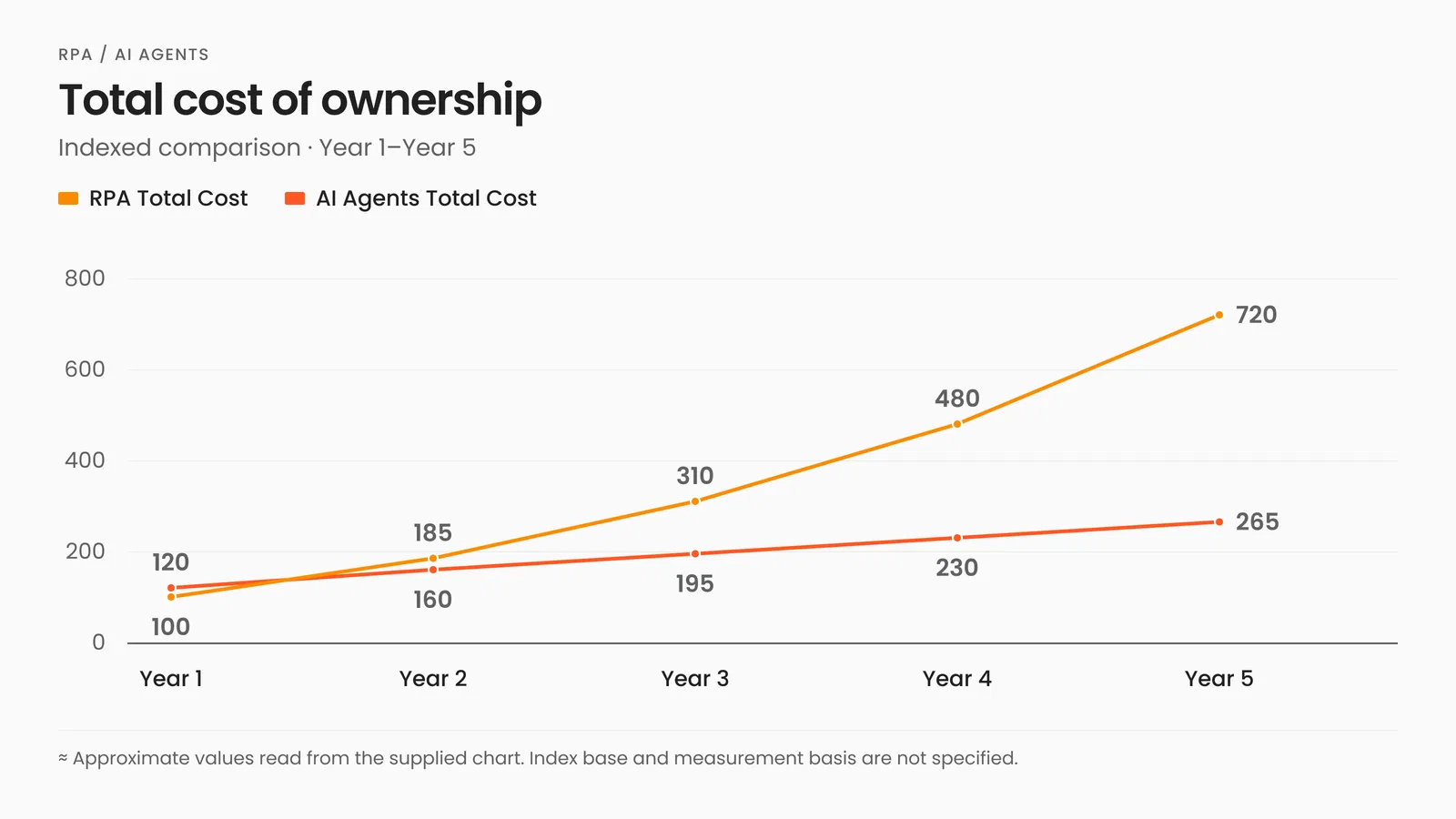
RPA costs compound linearly as bot estates grow. AI agent costs stay sub-linear.
The Maintenance Tax Is Real
Industry estimates consistently put 30 to 40% of enterprise RPA maintenance hours toward repairing breakage, a figure echoed across multiple automation-vendor and analyst commentary. For a team managing 200 bots, that is the equivalent of 60 to 80 full-time weeks per year spent fixing what already worked yesterday. This is the hidden cost of legacy automation that most ROI calculators miss.
Exception Rates Drop Dramatically
Among teams that migrated high-exception RPA bots to AI agents, median exception rates dropped from above 15% to under 3% within the first 30 days (G2 Enterprise AI Agents Report, 2025). That is not a gradual improvement. It is an immediate operational shift that directly impacts workflow automation quality.
Production Adoption Is Already Mainstream
AI agent adoption surged from 20% to 57% in a single year (G2, 2025). RPA growth is flatlining.
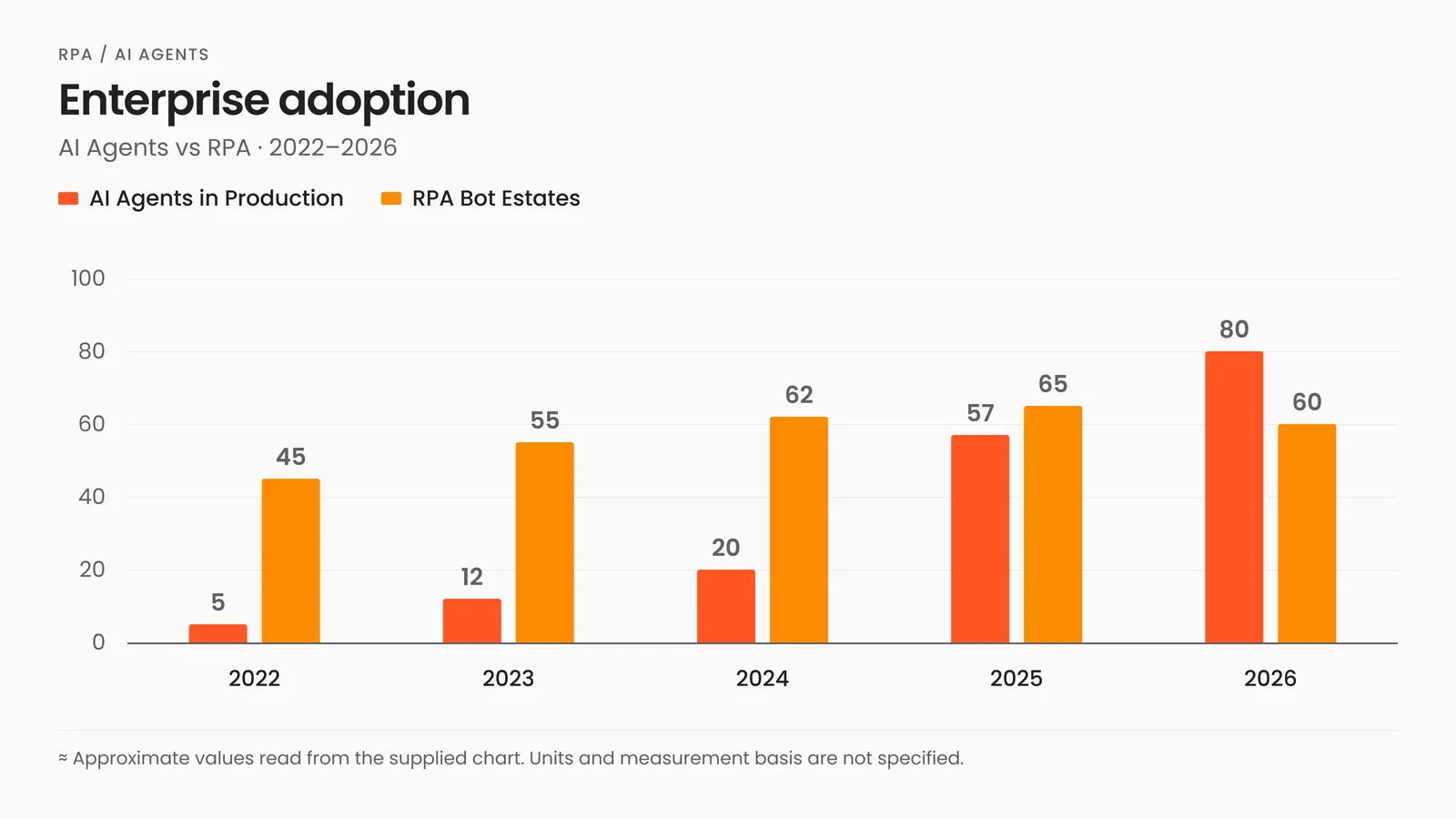
57% of companies have AI agents running in production (G2, 2025). This is not an emerging technology. It is the new default for new business process automation projects. If you are still evaluating an RPA alternative, your peers have already started deploying.
RPA Vendors Are Adapting (Or Trying To)
Even traditional RPA vendors acknowledge the shift. UiPath’s CTO stated in 2026: “UiPath is no longer an RPA company. We are an RPA plus process orchestration plus solutions company.” The industry is converging toward agentic process automation because the market demands it. Forrester’s June 2026 research on the state of agentic AI found that roughly three-quarters of enterprises are now adopting agentic AI in some form, though it also found that few have scaled it past pilots, which is exactly the gap this migration guide is meant to help you close.
How to Migrate from RPA to AI Agents: The 3-Phase Approach
The recommended strategy from industry practitioners is augment-then-replace. Keep stable RPA bots running, layer AI agents on exception-heavy workflows first, and retire brittle bots over 12 to 24 months. This is the RPA migration framework that minimizes risk.
Phase 1: Stability Audit (Weeks 1 to 2)
Review your current automation estate. For every active RPA bot, record three metrics:
- Monthly run volume
- Monthly exception count (runs requiring human intervention)
- Input format (structured vs. unstructured)
Calculate the exception rate: exceptions divided by total runs. Bots with exception rates above 10% and unstructured inputs are your highest-priority migration targets. This audit is the first step in any serious RPA migration.
Phase 2: Complexity Swap (Weeks 3 to 8)
Build AI agent workflows for your highest-exception bots. Run them in parallel with existing RPA bots for 30 days before decommissioning. Compare outputs, exception rates, and processing times.
A pilot agent process is typically live in 4 to 8 weeks. ROI is reported per process, not per bot. If you want to see this in action, book a demo with Shogo to see how intelligent agents handle complex workflows.
Phase 3: New Value Expansion (Months 3 to 12)
Focus new development efforts on AI agents. Target workflows that were previously rejected for business process automation because they involved too much unstructured data or judgment calls. This is where the highest ROI lives: automating tasks that were previously exclusive to human workers.
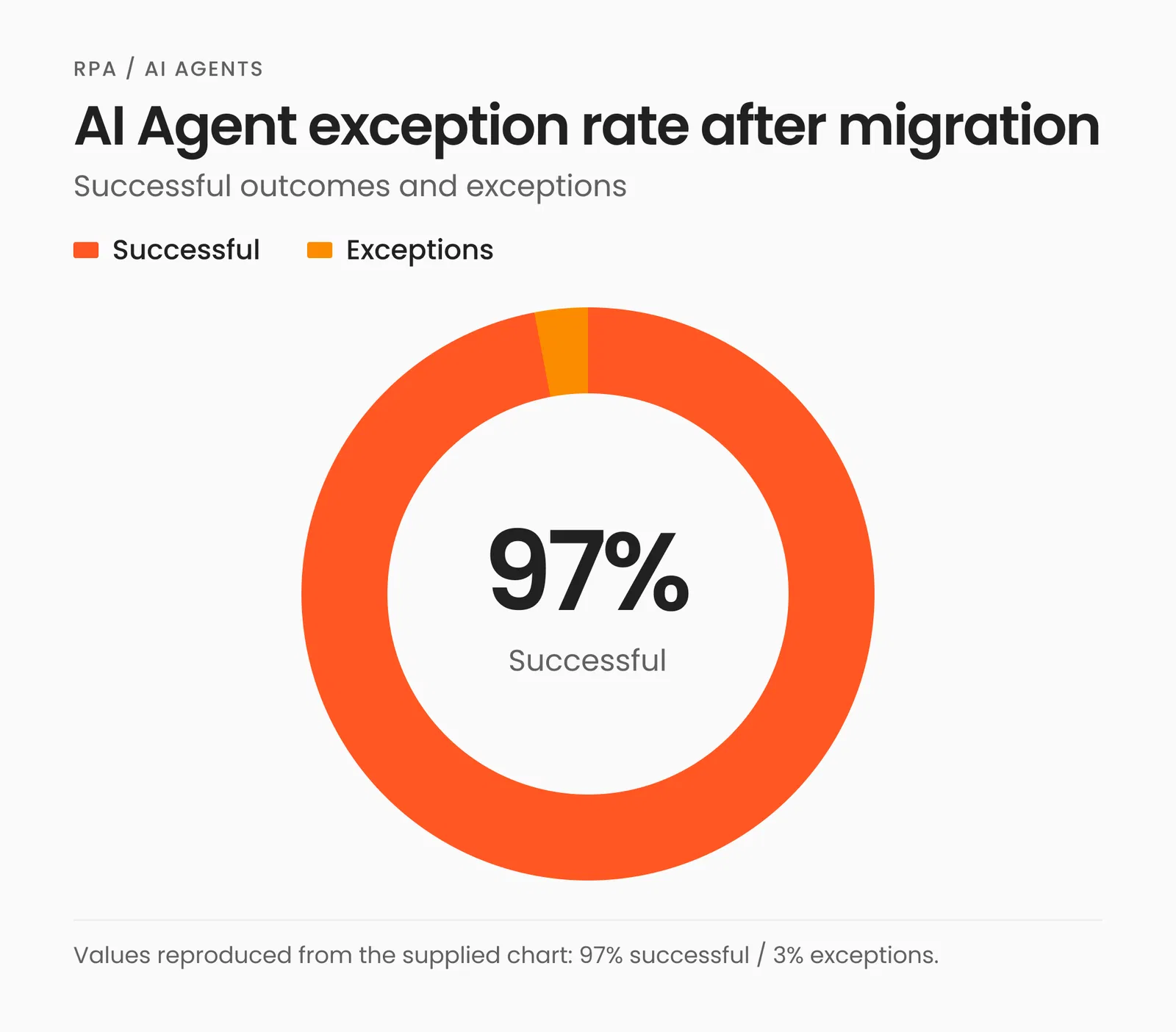
After migration, 97% of transactions complete autonomously. Only genuinely ambiguous cases reach humans.
"Organizations that augment-then-replace typically complete their highest-value migrations within four to six weeks, faster than a single RPA bot development cycle." (Heym, 2026)
The TCO Model That Justifies the Switch
Build a 3-year total cost of ownership comparison:
RPA costs (3 years): - Licensing fees (often per-bot, penalizing scaling)
- Maintenance team (growing linearly with bot count)
- Breakage repair (30 to 40% of engineering hours)
- Opportunity cost of unautomated workflows
AI agent costs (3 years): - Platform fees (often usage-based)
- Maintenance (under 10% of engineering hours)
- Expanded automation scope (previously impossible workflows now automatable)
- Compounding returns as agents handle more complexity
Most enterprises find the crossover point at 18 to 24 months, where AI agent TCO drops below RPA TCO and continues to diverge. For CFOs building the business case, see our ROI framework for AI-powered automation investments.
What Enterprise Buyers Should Evaluate in an AI Agent Platform
The ROI case for AI-powered automation strengthens when you model the full 3-year picture.
If you are an RPA buyer evaluating an RPA alternative, these are the criteria that matter in an automation platform:
Security and Compliance
- Encrypted credential storage at rest and in transit
- Scoped access controls limited to actual needs
- Full audit trails for compliance and debugging
- SOC 2, ISO 27001, and industry-specific certifications
- Deterministic policy enforcement for regulated industries
Architecture
- Computer vision for UI navigation (not just API-based)
- LLM-powered reasoning for exception handling
- Hybrid orchestration (agentic workflows plus deterministic rules)
- Visual workflow builder for non-technical users
Migration Support
- Parallel operation with existing RPA bots
- Webhook integration for hybrid agent-plus-RPA workflows
- Historical data import for agent training
- Performance benchmarking tools
Scalability
- Usage-based pricing that does not penalize growth
- Multi-process orchestration across departments
- Self-healing capabilities that reduce human intervention
- Cross-system integration without per-bot licensing
The Future: Where Enterprise Automation Is Headed
Gartner already predicts that 40% of enterprise applications will embed task-specific AI agents by the end of 2026, up from under 5% in 2025, and Forrester’s 2026 research shows three-quarters of enterprises already adopting agentic AI in some form. RPA will not disappear, but it will be relegated to the specific niche where it excels: stable, structured, API-less legacy systems.
The convergence is already happening. RPA vendors are adding agent layers. Agent platforms are adding deterministic guardrails. The boundary between the two technologies is blurring, and the winners will be enterprises that adopted the hybrid model early. For teams navigating digital transformation, the question is no longer whether to evaluate AI-powered automation. It is how fast you can deploy. The enterprises winning the digital transformation race are not the ones with the most bots. They are the ones that replaced brittle scripts with intelligent, adaptive agents.
Three trends shaping the next phase of intelligent automation:
- English-as-Code. Business users building workflow automation in natural language, eliminating the IT backlog that slowed RPA development: a shift from writing bot scripts to simply describing the outcome you want.
- Multi-agent orchestration. Teams of specialized agents coordinating across departments, handling business process automation that spans sales, support, finance, and operations.
- Neurosymbolic architectures. Hybrid systems combining LLM reasoning with deterministic rule enforcement, delivering the adaptability of agentic automation with the auditability that regulated industries require.
FAQ
What is the main difference between RPA and AI agents?
RPA follows predefined, rule-based scripts to automate structured, repetitive tasks. It breaks when inputs change or exceptions occur. AI agents use large language models to reason through tasks, handle unstructured data, and adapt to exceptions without human intervention. The difference matters most for workflows with variable inputs or high exception rates.
Can AI agents completely replace RPA?
Not immediately. The recommended approach is augment-then-replace. Keep RPA bots running on stable, legacy applications where the interface never changes. Layer intelligent automation on exception-heavy and unstructured workflows first. Most enterprises find that 60 to 70% of their RPA surface area can be retired within 12 to 18 months.
How long does it take to migrate from RPA to AI agents?
A pilot agent process is typically live in 4 to 8 weeks. A multi-process RPA migration program that retires 30 to 60% of an RPA estate typically runs 12 to 18 months, sequenced by business value and exception frequency.
Are AI agents secure enough for regulated industries?
Modern AI agent platforms use encrypted credential storage, scoped access controls, full audit trails, and deterministic policy enforcement for compliance. Neurosymbolic architectures combine LLM reasoning with rule-based guardrails, delivering hallucination-free automation that satisfies SoX, NYDFS, and DORA audit requirements.
What is the cost comparison between RPA and AI agents?
RPA has lower upfront licensing for simple processes but carries escalating maintenance costs (30 to 40% of engineering hours on breakage repair). AI agents require higher initial investment but deliver sub-linear maintenance costs. The TCO crossover typically occurs at 18 to 24 months, after which AI-powered automation becomes significantly cheaper per process automated.
Related Reading
- What is Agentic Automation?
- AI Glossary: Essential Terms
- Top Agentic Automation Tools
- Shogo vs UiPath
- ROI of AI Agents: CFO Framework
Looking for definitions? See our AI Glossary.
Sources
- Gartner. “Gartner Predicts 40% of Enterprise Apps Will Feature Task-Specific AI Agents by 2026.” Gartner Newsroom, 26 August 2025.
- Gartner. “Deploy Semiautonomous AI Agents for Optimal Business Process Automation.” Gartner Research, 28 November 2025.
- Gartner. “Agentic Automation Requires Design: 3 Methodologies to Get Started.” Gartner Research, June 2026.
- G2. “Enterprise AI Agents Report: Industry Outlook for 2026.” G2, December 2025 (based on G2’s August 2025 survey).
- Forrester. “The State of Agentic AI in 2026: Companies Are Chasing, Few Are Catching.” Forrester Blog, 3 June 2026.
- Kognitos. Company blog commentary on unstructured data and enterprise automation, 2026.
- UiPath CTO Raghu Malpani, quoted in Analytics India Magazine. “What is UiPath’s Moat in 2026?” June 2026.
- The 30-40% RPA maintenance-overhead estimate and the 25-50% early-adopter cost-reduction range are widely cited across automation-vendor and analyst commentary; treat as industry consensus estimates rather than a single primary study.
About the Author Shogo Editorial Team Our editorial team specializes in enterprise automation, agentic AI, and the technology decisions that shape modern operations. We publish practical guides based on real data, not hype. Start automating today: book a demo. Questions or feedback? Reach us at [email protected].
Originally published: August 2026. Rewritten and fact-checked: October 2026 — removed unsupported third-party statistics and replaced them with sourced, verifiable data.